

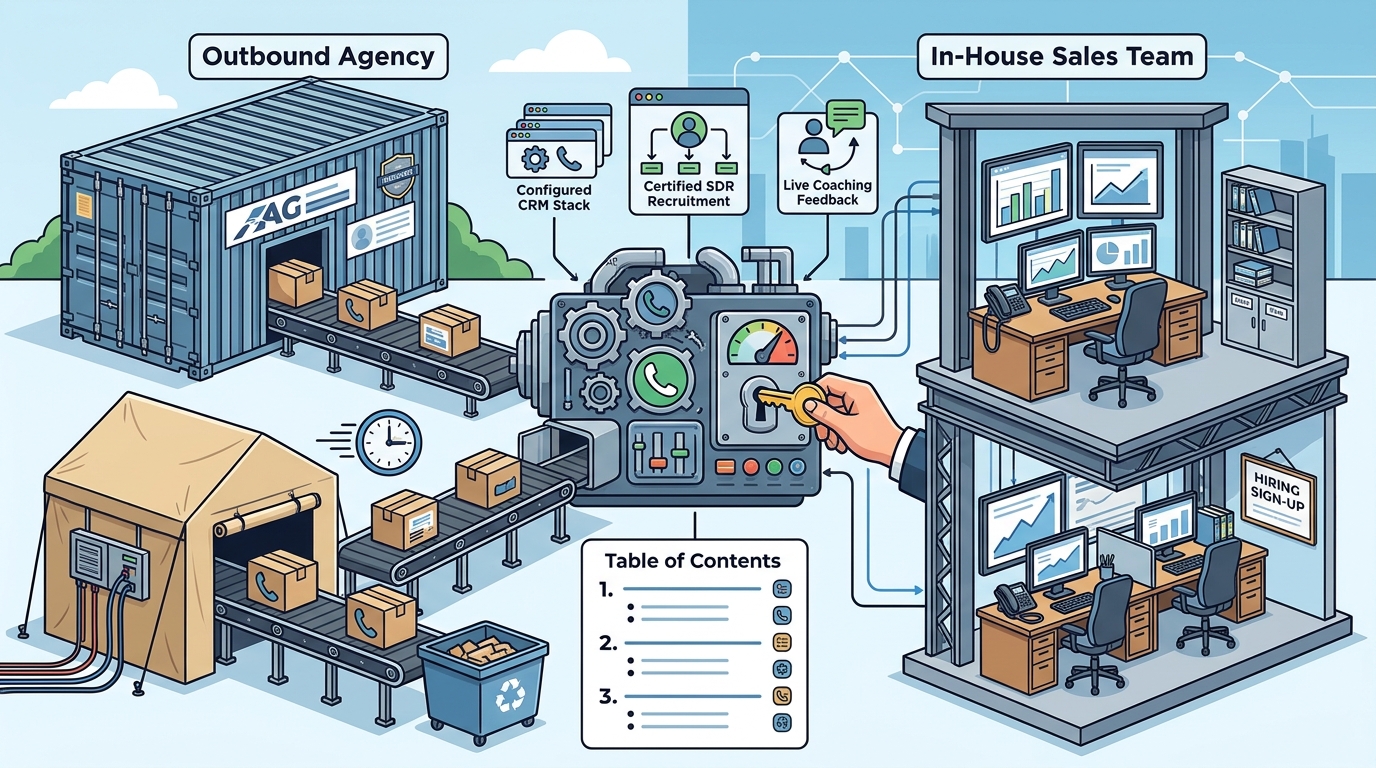
Choosing between an outbound agency and an in-house team depends on whether you need immediate pipeline or long-term asset ownership. An outbound agency is a third-party firm that executes sales outreach on your behalf, while an in-house team is a group of employees you hire, manage, and own. Outbound Operators bridges this gap by installing a phone-first system, hiring your reps, and handing over the keys so you retain full control of the engine.
The Agency Model: Speed and Outsourced Execution
Many B2B companies start with an agency to generate pipeline quickly without the overhead of hiring. An agency typically provides its own sales development representatives (SDRs) who dial, email, and book meetings under the agency's management. This model offers speed because the agency already has a bench of trained reps and established tooling. However, the agency owns the process, the data, and the relationships. When you stop paying, the pipeline stops. You do not build internal capability. You rent it. This creates a dependency that can be costly over time. If your goal is to build a durable sales organization, renting reps is a temporary fix, not a foundation.
The In-House Model: Ownership and Long-Term Value
Building an in-house team means hiring SDRs who are your employees. You own their performance, their data, and their institutional knowledge. This model creates a long-term asset. Your reps learn your product, your market, and your ideal customer profile deeply. They become a core part of your go-to-market strategy. The challenge is time. Hiring, onboarding, and coaching SDRs takes months. Most companies struggle to find reps who can actually hold a conversation. Many hires fail because they lack the specific skill of live phone selling. Without a structured training system, in-house teams often stall. They dial, but they do not connect. They connect, but they do not convert. The gap between hiring and producing pipeline is where most in-house efforts fail.
The Hybrid Approach: Install, Operate, Hand Over
Cost and ROI Considerations
Cost structures differ significantly between these models. Agencies typically charge a monthly retainer for their services. You pay for the output, but you do not own the input. In-house teams require salary, benefits, tooling, and management time. The upfront cost is higher, but the long-term cost per meeting is often lower. Outbound Operators structures its engagement to align with your goals. We start with a diagnostic to validate your market. Then we build the system. We recruit your reps. We coach them. We track every stage from connect to SQL. The investment is in building your capability, not renting someone else's. This shifts the ROI calculation from monthly spend to long-term asset value.
How to Decide: A Practical Framework
Use this framework to evaluate your options. First, assess your current pipeline. Do you need meetings this quarter? If yes, speed is critical. Second, assess your hiring capacity. Can you find and train SDRs who can sell on the phone? If no, you need a training system. Third, assess your ownership goals. Do you want to build a team you can keep? If yes, avoid agencies that retain their reps. Outbound Operators is designed for companies that want to own their outbound engine. We are not a lead generation agency. We are not an appointment-setting service. We are an installation partner. We build the system, find and hire your reps, and train them. Then we hand over the keys. Whether we stay for ongoing coaching or step back is your choice. The engine is yours.
Key Takeaways
- An outbound agency is a third-party firm that executes sales outreach on your behalf, while an in-house team is a group of employees you hire, manage, and own.
- Agencies provide speed but create dependency; in-house teams provide ownership but require significant time and training.
- Outbound Operators installs a phone-first system, hires your reps, and hands over the keys so you retain full control.
- The hybrid approach combines immediate pipeline generation with long-term internal capability building.
- Cost structures differ: agencies charge for output, in-house teams require salary and management, and installation partners invest in your capability.
- Use a practical framework to evaluate your pipeline needs, hiring capacity, and ownership goals.
- Results referenced reflect specific client engagements and are not a guarantee of future performance.
Frequently Asked Questions
What is the main difference between an outbound agency and an in-house team?
The main difference is ownership. An agency owns its reps and process. An in-house team is owned by you. Outbound Operators bridges this by installing a system where you own the reps and the data.
Does Outbound Operators act as a traditional agency?
No. We are not a lead generation agency or an appointment-setting service. We build the system, hire your reps, and hand over the keys. You own the engine.
How long does it take to build an in-house outbound team?
It varies, but typically takes months. Outbound Operators installs the system in 60 days, with reps having 10 to 12 conversations per hour instead of 1 to 2 per day.
Who owns the data and reps in the Outbound Operators model?
You do. We recruit and train your SDRs. They are your employees. The data is in your CRM. The process is documented and yours to keep.
Can I switch from an agency to an in-house team later?
Yes, but it requires building the capability. Outbound Operators helps you make this transition by installing the system and training your team before handing over the keys.
What is the Outbound GTM Diagnostic?
It is a 90-minute session where we call your market live and hold 20 to 30 real buyer conversations. You leave with a validated message and a go/no-go readiness report.
Conclusion
The choice between an outbound agency and an in-house team is not just about cost. It is about ownership and long-term value. If you want to rent pipeline, an agency may work. If you want to build a durable sales organization, you need a system you own. Outbound Operators installs that system. We build the engine, hire your reps, and hand over the keys. To plan your visit, .