

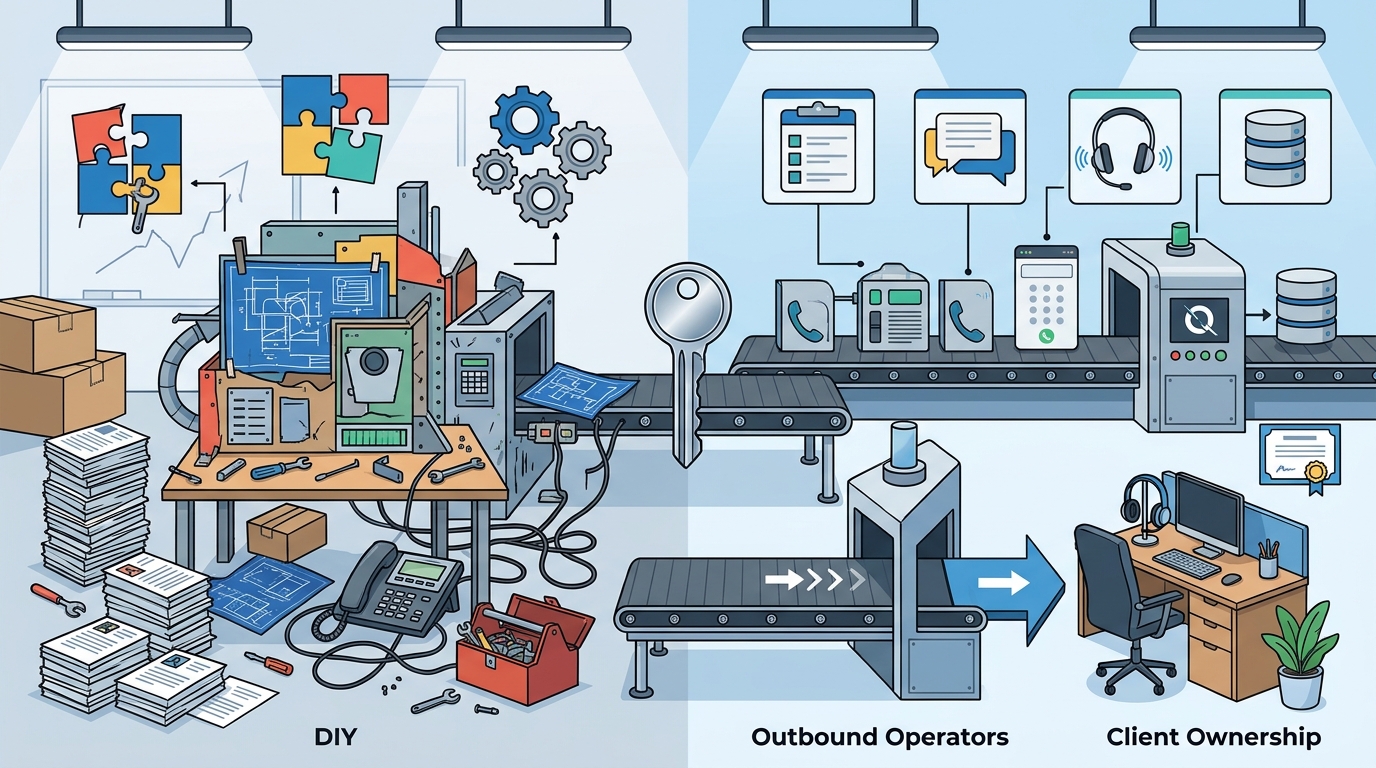
Choosing between a managed handoff model and building your sales team in-house is a critical decision for B2B companies. The managed handoff model is a service where a partner builds, hires, and trains your team, then transfers full ownership to you. The DIY model is a traditional approach where you recruit, onboard, and manage every aspect of your sales development team yourself. Outbound Operators specializes in the managed handoff approach, installing a phone-first outbound engine that you ultimately own. This comparison helps you decide which path aligns with your current resources and timeline.
The Managed Handoff Model
The managed handoff model is designed for companies that need predictable pipeline quickly but lack the internal infrastructure to build it from scratch. In this model, a specialized partner handles the heavy lifting of system design, tooling configuration, and talent acquisition. The partner operates the system alongside your leadership until it produces consistent results. Once the engine is stable, the partner hands over the keys, leaving you with the system, the data, and the reps.
Strengths of the Managed Approach
The primary advantage is speed and expertise. You gain access to proven playbooks and experienced operators who have built these systems before. This reduces the trial and error that often plagues new sales teams. For example, Outbound Operators installs a system where reps have 10 to 12 conversations per hour, a significant jump from the typical 1 to 2 per day. The partner manages the daily coaching and reporting, ensuring that the team stays aligned with the target metrics.
Limits and Considerations
The main limitation is the initial cost and dependency on the partner. You are paying for expertise and speed, which can be a significant investment. However, the goal is to reduce this dependency over time. The partner should provide a clear roadmap for transition, ensuring that your internal team is ready to take over. It is crucial to define the handoff criteria early to avoid ambiguity about when the partner’s role ends.
The DIY In-House Model
The DIY in-house model is the traditional route for building a sales team. You are responsible for every step, from defining the ideal customer profile to hiring the first SDR. This approach gives you full control over the process and culture. You build the systems, choose the tools, and manage the coaching directly. It is a hands-on approach that requires significant time and attention from your leadership team.
Strengths of the DIY Approach
Full control is the biggest benefit. You can tailor every aspect of the sales process to your specific company culture and product. There is no external dependency, and you build internal capabilities that are unique to your organization. This model is ideal for companies that already have strong sales leadership and a clear vision for how they want to operate. It allows for deep customization and long-term strategic alignment.
Limits and Considerations
The DIY model is time-intensive and risky. Building a sales engine from scratch can take months or even years. You may face high turnover rates, as finding and retaining top-tier SDRs is difficult. Without proven playbooks, you may waste time on tactics that do not work. The cost of failure is high, as you are investing your own time and resources into an unproven system. It requires a high tolerance for uncertainty and a willingness to iterate slowly.
Comparison Table
| Criteria | Managed Handoff | DIY In-House |
|---|---|---|
| Time to First Pipeline | Fast (weeks) | Slow (months) |
| Initial Cost | Higher (service fee) | Lower (salaries only) |
| Expertise Access | High (partner’s IP) | Variable (internal learning) |
| Control | Shared (during build) | Full |
| Risk | Lower (proven systems) | Higher (trial and error) |
| Long-Term Ownership | Full (after handoff) | Full |
Decision Guidance
Choosing the right model depends on your current stage and resources. Here is a guide to help you decide.
Choose Managed Handoff If
- You need pipeline this quarter and cannot wait months for a team to ramp up.
- You are hiring or about to hire SDRs but lack the infrastructure to support them.
- You have tried outbound before and watched it fail due to lack of system or coaching.
- You want to own the system and data but do not want to build it from scratch.
Choose DIY If
- You have strong sales leadership with experience building outbound teams.
- You have a long-term horizon and can tolerate a slower ramp-up period.
- You want full control over every aspect of the sales process and culture.
- You have the budget for salaries but not for a service fee, and you are willing to invest time.
Frequently Asked Questions
What happens to the data and tools after the handoff?
You own everything. The managed handoff model is designed to transfer full ownership of the system, data, and tools to you. The partner does not retain any proprietary rights to your customer data or your internal processes. You are free to modify the system as you see fit after the handoff.
How long does the managed handoff process take?
It varies, but a typical installation takes about 60 days. This includes building the system, hiring and training reps, and running the engine until it is stable. The exact timeline depends on your market and the complexity of your sales process.
Can I switch from DIY to managed handoff later?
Yes, but it can be disruptive. If you have already built a team and systems, switching to a managed handoff may require retraining or replacing some of your infrastructure. It is usually more efficient to choose the right model from the start.
What is the cost difference between the two models?
The managed handoff model has a higher initial cost due to the service fee. However, it may be more cost-effective in the long run if it reduces the time to profitability and lowers the risk of failure. The DIY model has lower upfront costs but higher ongoing costs in terms of time and potential inefficiencies.
Do I need to fire my current SDRs if I choose managed handoff?
Not necessarily. The partner can work with your existing team or recruit new reps. The goal is to build a system that works, not to replace people. If your current SDRs are a good fit, they can be integrated into the new system. Learn more: Outbound Operators We install.