

Outsourced SDR teams provide immediate execution but lack long-term asset ownership, whereas in-house teams build durable institutional knowledge and proprietary data. The right choice depends on whether you need temporary pipeline coverage or a permanent revenue engine. Outbound Operators helps B2B companies navigate this decision by installing phone-first systems that clients fully own.
The Core Difference: Asset Ownership
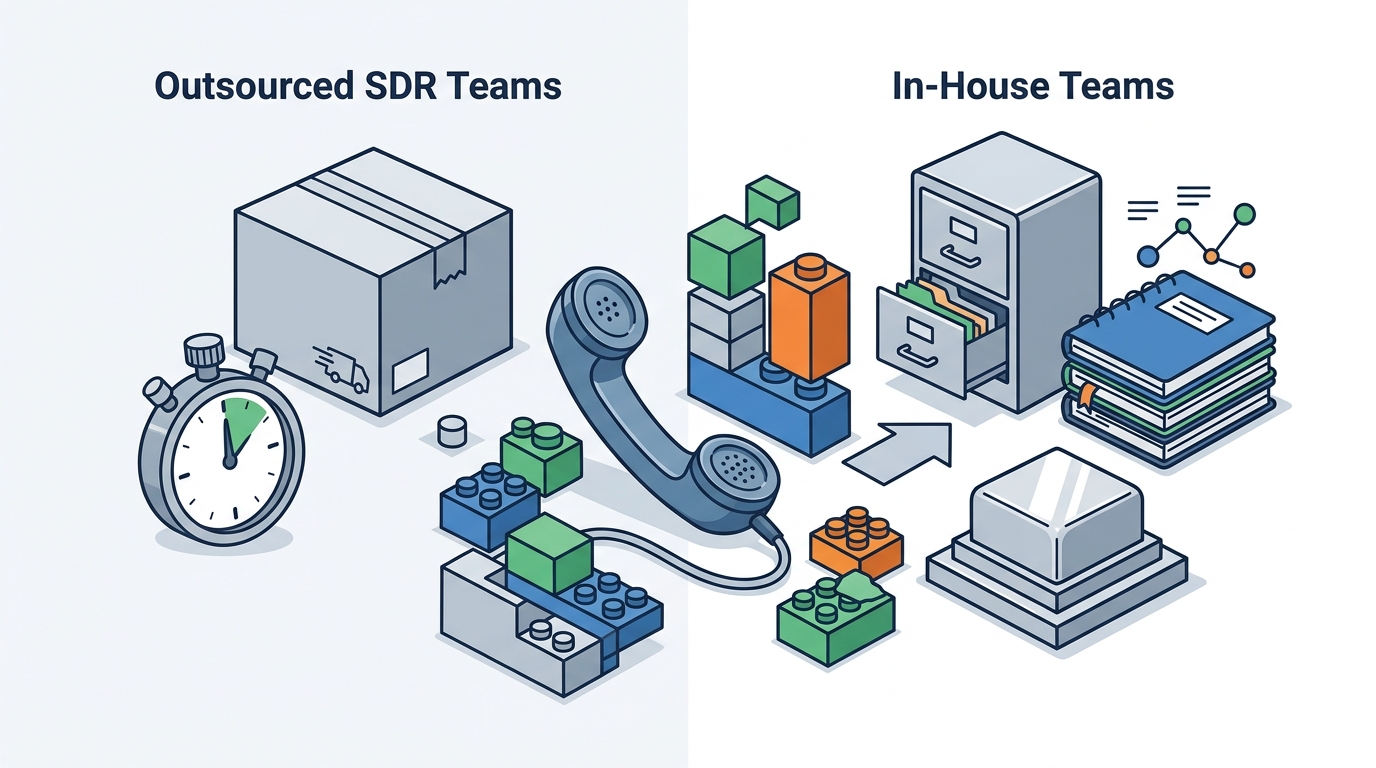
Outsourced SDR agencies operate on a service model where the vendor retains control over the process. In this setup, the agency hires, trains, and manages the reps. The client receives meetings or leads, but the underlying system, data, and talent belong to the vendor. When the contract ends, the capability disappears. In-house SDR teams operate on an asset model. The company hires the reps directly. The company owns the CRM data, the dialer configuration, and the institutional knowledge. This distinction is critical for long-term scalability.
Outsourced SDR agency is a service provider that executes outbound tasks on behalf of a client without transferring ownership of the sales infrastructure. In-house SDR team is a group of employees hired directly by the company to own and operate the outbound sales process. The implication is clear: if you want a permanent revenue channel, you must own the engine. If you only need short-term coverage, a service model may suffice.
Cost Structure and Unit Economics
Speed to Market and Ramp Time
Outsourced teams can start dialing within days. The agency already has reps, tools, and processes in place. This speed is valuable for companies that need pipeline immediately. In-house teams take longer to build. Recruiting, onboarding, and training a new SDR can take 60 to 90 days. During this time, the rep is not generating pipeline. This delay is a significant drawback for companies under revenue pressure.
However, speed is not the only metric. A rep who is not trained on your specific market will waste dials and burn through your list. Outbound Operators addresses this gap by installing a managed fractional cold caller who starts dialing within one business day. This allows the client to generate pipeline immediately while the in-house team is being built. The implication is that a hybrid approach can mitigate the ramp time risk of an in-house team.
Data Ownership and Intelligence
Outsourced agencies often use their own data and tools. The client may not have access to the raw call recordings, the scoring data, or the dialer logs. This creates a black box. You cannot optimize what you cannot see. In-house teams operate on your data. You own the CRM, the dialer, and the recordings. This allows you to refine your messaging and targeting based on real feedback. The implication is that data ownership is a strategic advantage that compounds over time.
For example, Management Controls tripled their SQLs from 124 to 370 per year after installing an in-house system. They achieved this with 4 reps instead of the 34 originally planned. This outcome was possible because they owned the data and could iterate on their process. An outsourced agency would not have provided this level of transparency. The implication is that in-house teams enable continuous improvement, while outsourced teams lock you into a static process.
Choosing the Right Model for Your Stage
The right choice depends on your company stage and goals. If you are pre-product-market fit, you should not be doing outbound at all. If you are venture-backed and need pipeline this quarter, an outsourced team may be a stopgap. If you are scaling and want a permanent revenue engine, you should build in-house. Outbound Operators helps companies make this decision by running a 90-minute diagnostic. We call your market live and hold 20 to 30 real buyer conversations. This gives you a go/no-go readiness report before you commit to a build.
The implication is that you should not guess. You should test. A diagnostic allows you to validate your message and your market before you spend money on a team. This reduces risk and increases the likelihood of success. The implication is that data-driven decision making is the best way to choose between outsourced and in-house models. according to Placement Tests Diagnostics
Key Takeaways
- Outsourced SDR agencies provide speed but lack asset ownership.
- In-house SDR teams build durable institutional knowledge and proprietary data.
- Outsourced models have variable costs; in-house models have higher fixed costs but lower marginal costs.
- In-house teams take 60 to 90 days to ramp, while outsourced teams can start immediately.
- Data ownership is a strategic advantage that compounds over time.
- A hybrid approach can mitigate the ramp time risk of an in-house team.
- Run a diagnostic before committing to a build to validate your message and market. according to Placement Tests Diagnostics
Frequently Asked Questions
What is the main difference between an outsourced SDR and an in-house SDR?
The main difference is ownership. An outsourced SDR is employed by an agency, and the agency owns the process and data. An in-house SDR is employed by the company, and the company owns the process and data.
How long does it take to build an in-house SDR team?
It typically takes 60 to 90 days to recruit, onboard, and train an in-house SDR team. This includes time for the reps to become proficient with the tools and messaging.
Can I switch from an outsourced team to an in-house team?
Yes, but it requires a transition plan. You need to ensure that the data, tools, and processes are transferred to your team. Outbound Operators can help with this transition by building the system and handing it over to you.
What is the cost of an outsourced SDR team?
Outsourced SDR teams typically charge a monthly retainer or a per-meeting fee. Costs vary widely depending on the agency and the scope of the engagement.
What is the cost of an in-house SDR team?
How do I know if outbound is right for my company?
Run a diagnostic. Outbound Operators runs a 90-minute diagnostic where we call your market live and hold 20 to 30 real buyer conversations. This gives you a go/no-go readiness report before you commit to a build.
Do outsourced agencies own the data they generate?
It depends on the contract. Some agencies allow the client to own the data, while others retain ownership. You should clarify this in the contract before signing.
Conclusion
The choice between an outsourced SDR team and an in-house team is a strategic decision. Outsourced teams provide speed but lack asset ownership. In-house teams build durable institutional knowledge and proprietary data. The right choice depends on your company stage and goals. Outbound Operators helps B2B companies navigate this decision by installing phone-first systems that clients fully own. To plan your visit, book a 30-minute call with our team.